

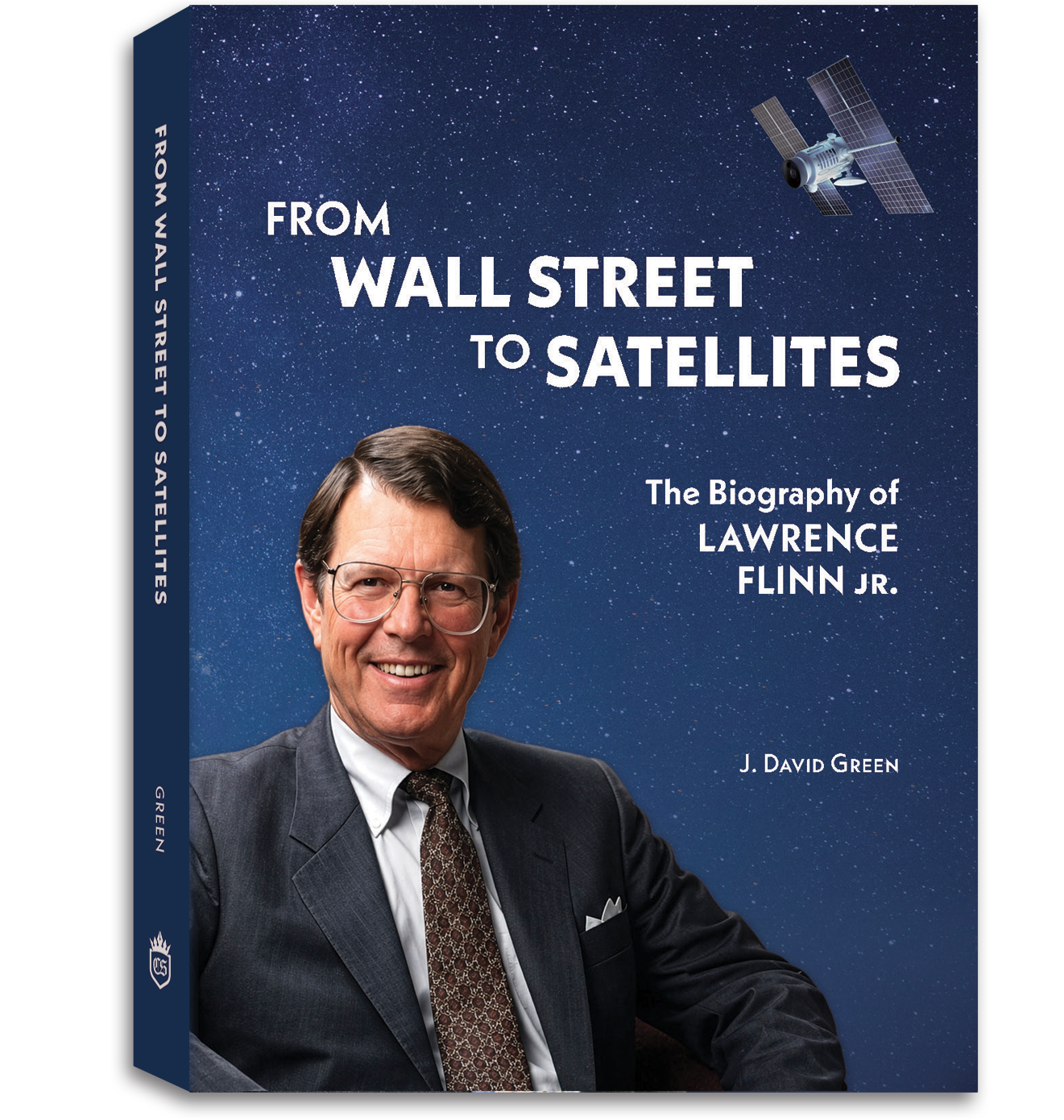
From Wall Street to Satellites
The Biography of
Lawrence X Jr.
J. David Green

(Click the pages to view a larger image.)
With a passion for entrepreneurship and a keen analytical mind, Larry F purchased a small cable television company in a suburb of Binghamton, New York. He then won multiple franchise bids and acquired other vendors in the region before spreading into several more states.
After selling his company, Larry acquired United Video, which transmitted TV signals via microwave before transitioning to satellite technology. United Video Satellite Group grew rapidly, going public in the early 1990s. UVSG drew the attention of TCI, which ultimately bought the company. In 1997, Larry stepped down as CEO and Chairman.
Larry spotted an emerging industry in the technology sector—cable television. Never having even heard of cable TV, he asked, “Can someone explain to me what cable is?” That someone was Bill Daniels. Having launched his own cable company in the early ’50s, he was the first cable system operator using terrestrial microwaves to relay TV signals, in his case, from Denver to Casper, Wyoming. In 1958, Daniels was also the first in the industry to provide brokerage services to other cable system owners.
The first opportunity Daniels shared with Larry was the listing of a small system in Waynesville, North Carolina. He recalled learning about its founder. “A man by the name of Bill Turner had financed his cable franchise, Video Cable, in Waynesville with Economy Finance Corporation. Unfortunately, he was at risk of defaulting on his loan. “The interest rates were steep, about 14%,” noted Larry. “Bill was an excellent engineer. He understood how to build cable plants. He had a very simple problem—not generating enough revenue while the debt payments were eating his lunch. I could see the rate at which he was signing up customers.
I decided to model a pro forma financial projection, a skill I had developed at Morgan Stanley. I projected out his revenues and earnings before EBITDA, month by month until he became cash flow positive. Based on the rate of customer signups, I was able to project how his cash flow streams would run. If I put in the money he needed, he could get enough customers to generate the cash flow to meet his obligations.”
The deal was too small for Bogdan. “Instead, while continuing at Bogdan, I decided to invest $30,000 of my own money for 50% of the stock of the fledgling Company. Within a year, I was making a 125% return on my initial investment, while Bill Turner was running and growing the Company. “I thought, ‘Hey, this is a pretty good field to be in.’”
In 1964, the cable TV viewing experience was primitive, compared to today’s options. Most consumers today have streaming services, satellite TV, or cable TV, with instant access to hundreds of channels, twenty-four hours a day, seven days a week. They can access premium services like Netflix, HBO, Apple TV, Cinemax, YouTube TV, and Hulu. They can scroll through live and on-demand programs, watch previews, movies and TV shows on demand, and record shows and movies for later viewing. They can watch on high-definition, big-screen TVs, smartphones, and tablets. Such innovations would take decades to become reality.